Canvas Task Cards
Canvas Task Cards bring Operon tasks onto an Obsidian Canvas, where you can arrange a project, connect its work, and edit tasks without leaving the board. Use them when a spatial plan makes the relationships easier to understand than a list: a product launch, a development roadmap, or a project broken into several workstreams.
A card represents an existing Inline Task or File Task. It is another view of that task, linked by its operonId, so changes to its fields appear wherever the same task is shown. The Canvas holds the arrangement and connections; the task still lives in its Markdown source.
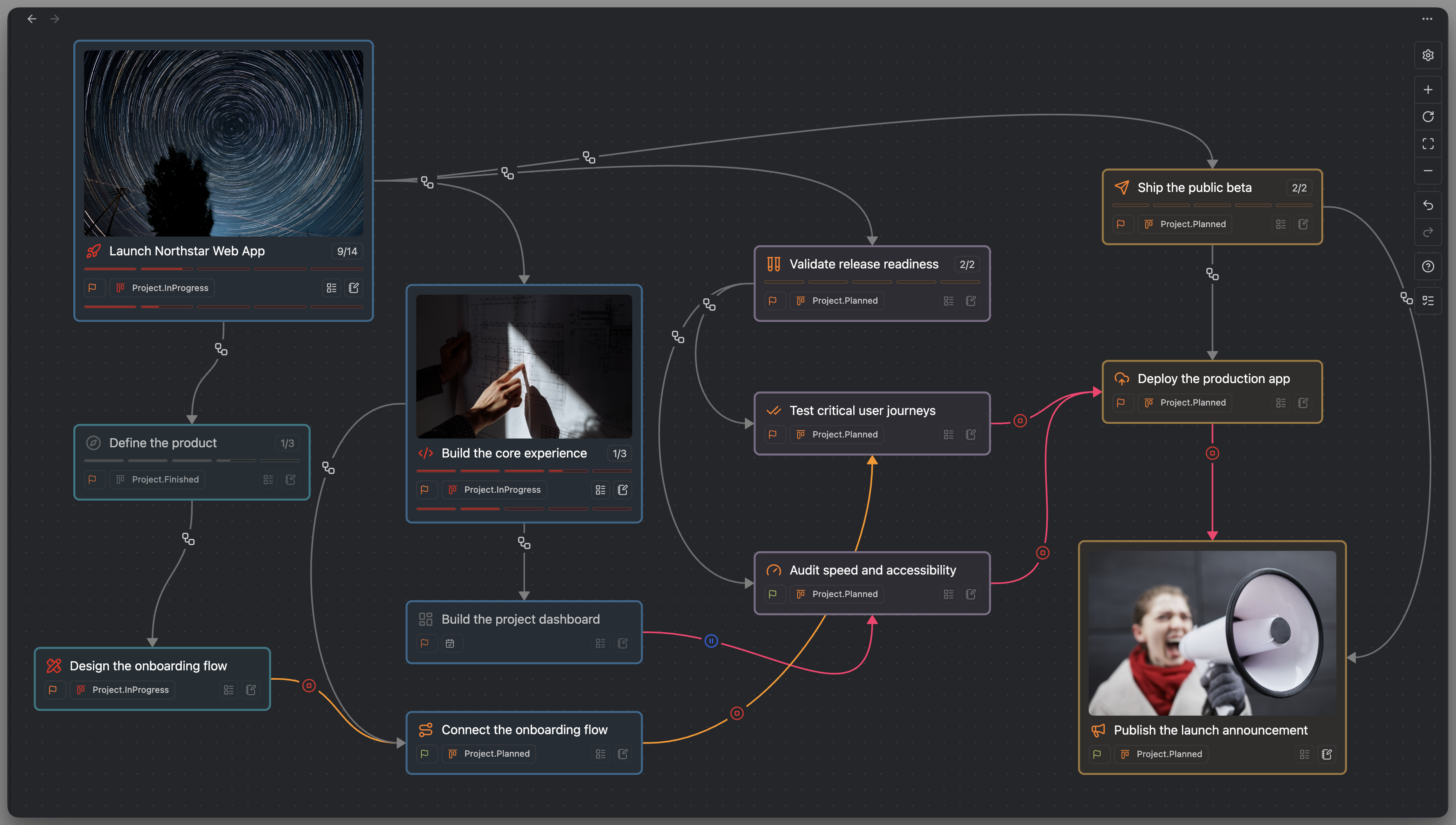
MEDIA-DOCS-141-1: General Canvas overview of the Northstar web app launch, showing parent tasks, their children, and blocking connections across the workstreams.
Add an existing task
Open an editable Canvas, then run Operon: Add task to Canvas from the command palette. Choose an Inline Task or File Task in Task Finder to place its card on the Canvas. The Canvas creation menu also offers Add Operon task for selecting an existing task at that location.
Adding a card does not move the task out of its source note or make a second task. You can show the same task on more than one Canvas, and each card continues to refer to the same identity. Copying a task card between canvases also keeps that source connection.
For adding several tasks while planning, use the Canvas Task Pool below.
Create a task from the Canvas
Convert a text card
Open the menu of a normal Canvas text card and choose Convert to Operon task…. The Task Creator opens with the card's text prepared for the new task: the description comes from its leading text, and the remaining content becomes its Note.
Review the fields and create an Inline Task or File Task. Operon replaces the text card with a linked task card and keeps its Canvas connections. The new card starts with the configured width and a height fitted to its content. The task's Markdown destination follows the task creation and Task Router rules.
Create from a connection
Drag a connection from a card into empty Canvas space. In the resulting menu, choose Add Operon task, then complete the Task Creator. Operon places the new card at the drop location and keeps the connection.
When the connection starts from an Operon task card, the new task is prepared as its subtask, with the parent and configured inheritance applied. Review that context in Task Creator before creating it. A connection from an ordinary Canvas card does not supply an Operon parent.
This is useful for breaking a project down as you think: start from the project card, create its workstreams, and then create the smaller tasks belonging to each workstream. See Parent and sub-tasks for how the task tree works independently of the visual layout.
Use the Canvas Task Pool
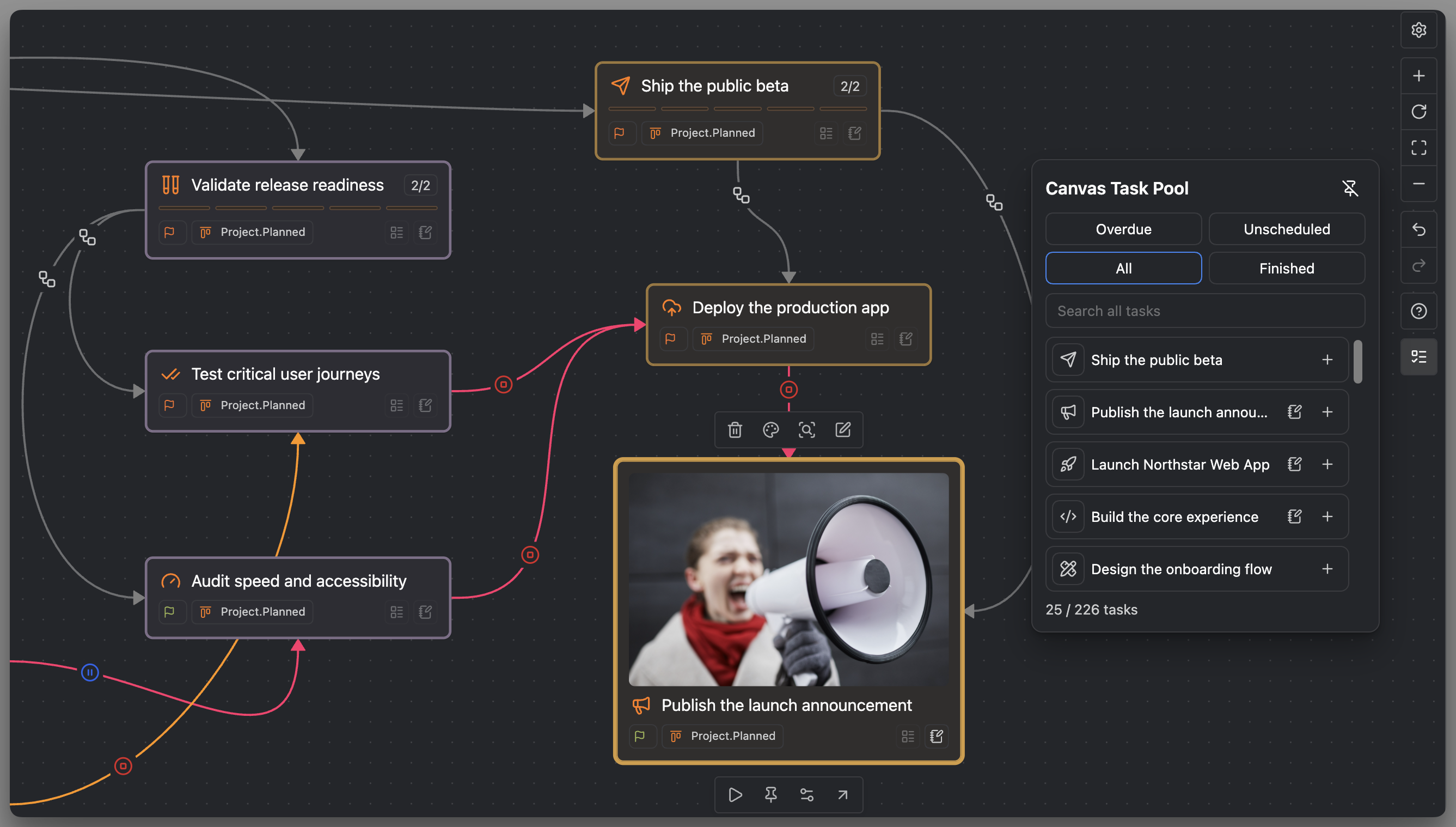
Open Canvas Task Pool from the Canvas controls. It is a floating, searchable list for bringing existing tasks onto the board.
| Mode | Tasks included |
|---|---|
| Overdue | Open tasks with a Scheduled or Due date before today |
| Unscheduled | Open tasks without a Scheduled date |
| All | All open tasks |
| Finished | Completed tasks, including those completed on earlier days |
The Canvas Task Pool is independent of the Calendar's selected date and preset filter. Search narrows the selected mode across its matching tasks, rather than just the rows currently displayed. More results load as you scroll.
For keyboard use, type in the search box to select the first matching result, move through tasks with the Up and Down arrow keys, and press Enter to add the selected task to the Canvas.
Use a row's + button to add its task. With a mouse, you can also drag the row onto the desired Canvas position. On touch screens, use + to add the task, then arrange its card on the Canvas.
Drag the panel header to move the pool out of your way. Pin Task Pool keeps it open while you add several cards or work elsewhere on the Canvas. An unpinned pool closes after a successful addition or an outside click. Use Unpin and close, or Escape, when you are finished.
Work with a task card
Select a card to reveal its task controls. Open editor opens the full Task Editor, and Jump to source takes you to the task's Markdown. Clicking the task description on the Canvas opens its compact text editor; dragging the card moves it without editing its title.
Cards can show:
- A task image, its title, and its task icon.
- Configured field chips, such as status, priority, dates, and dependencies.
- Task progress and descendant counts, with access to the task's subtree.
- Progress for the task's plain checklist.
- Action controls for time tracking, pinning, Notes, creating subtasks, and opening checkboxes.
Only enabled controls that apply to the task appear. Field chips use their normal editing or navigation behavior. Hover over the task icon to use its contextual menu; available actions follow the Task Cards surface in the Contextual Menu Matrix. See Task chips and Contextual menu actions.
Changes made through these controls update the source task. Moving a card around the Canvas changes its position, not its Scheduled or Due date.
Connect tasks and set relationships
Draw a normal Canvas connection between two Operon task cards, then select the connection. Operon adds four relationship controls: parent–child in either direction, and blocking in either direction.
A normal connection between existing cards is a visual link until you choose a task relationship. The arrowhead's direction does not decide which task must be the parent or the blocker. Choose the control whose tooltip describes the relationship you want.
Parent and child
The tooltip identifies both roles on separate lines:
Parent: Build the core experience
Child: Implement secure sign-in
That choice makes Implement secure sign-in a child of Build the core experience. The reverse control swaps the two roles. This updates the actual task tree, including the relationships visible in Task Editor and other Operon views.
Blocking and blocked by
A dependency means one task must be resolved before another can proceed. For example, Test critical user journeys blocks Deploy the production app.
The tooltip uses the same field terminology as Task Editor:
Blocked by: Test critical user journeys
Blocking: Deploy the production app
Read the first line as the prerequisite and the second as the task it blocks. In Task Editor, the deployment task lists testing under Blocked by; the testing task lists deployment under Blocking. The reverse control creates the opposite dependency.
Add, remove, or reverse a relationship
An inactive control is titled Add Relation. An active control is titled Current Relation; clicking it removes that relationship. To reverse an existing relationship of the same kind, remove the current one first, then select the opposite control.
Parent–child and blocking are separate relationships, so the same pair can have both. A visual arrow does not bypass the normal task relationship checks: Operon still rejects an invalid relationship or a task it cannot identify safely.
Removing a Canvas connection removes the visual line. Use the relationship control or Task Editor to remove the underlying task relationship.
Read the connection indicators
Operon draws relationship indicators on connections between matching task cards. The parent–child indicator sits on the parent's side of the connection. A dependency indicator sits on the blocking task's side.
An active blocker uses a red blocking indicator. When the blocker is resolved, the dependency uses the blue blocked-by indicator. This reflects the state of the prerequisite; it does not reverse the relationship. When both hierarchy and dependency exist, both indicators can appear on the connection.
The icons follow the corresponding canonical field mappings, so changes to Parent, Subtasks, Blocking, and Blocked by icons are also reflected in the appropriate Canvas controls. See Key mappings.
Plan a project with the Canvas Task Pool
Use the Task Pool to gather the work already captured across your notes and turn it into a project map. Keep the pool beside the Canvas while deciding which tasks belong in the plan, where they fit, and what depends on them.
For a web app launch, start with Launch Northstar Web App and arrange four workstreams beneath it: product definition, core development, release validation, and the public beta. Then build the plan from the pool:
- Pin the Task Pool so it stays open while you add and arrange cards. Move the panel to a free edge of the Canvas to keep the project visible.
- Find the relevant work. Use All and search to find the launch tasks already in your notes. Use Unscheduled when reviewing work that still needs a place in your schedule, or Overdue when checking what has slipped.
- Bring tasks onto the board. Drag a row to the workstream where it belongs, or use + and then position its card. Adding it to the Canvas does not assign a date or change its existing parent.
- Make the structure explicit. Connect the cards, then use the relationship controls to assign parents and children. Add blocking relationships across workstreams, such as testing before deployment. Placing cards near each other is visual organization; the relationship controls record the actual task links.
- Review progress in context. Switch the pool to Finished to bring completed work into the map when it helps explain what is already delivered. Existing cards continue to reflect their source tasks as work progresses.
The pool is a source of tasks for your plan, not a list limited to cards already on this Canvas. Changing its mode or search changes the available results; it does not remove cards you have placed. This lets you gather work in several passes without losing the arrangement.
MEDIA-DOCS-141-2: Canvas Task Pool open beside the Northstar launch plan, showing mode controls, search, and task rows ready to add to the project's workstreams.
Use the Canvas to decide how the work fits together, then use Calendar to place it in time or Gantt to review dates and dependencies along a timeline. These surfaces use the same tasks.
Appearance, removal, and Undo
Cards start at the configured default width and fit their content. You can arrange and resize them using Canvas controls. Changing the default width later does not resize existing cards.
Canvas task cards follow their source Task Color. Choosing a Canvas color for a task card updates that task's color, so its other cards follow the change. This does not recolor its subtasks automatically.
Removing a card from a Canvas leaves the source task intact. Use Task Editor's Remove action when you intend to delete the task itself and clean its relationships. See Task Editor.
Normal card placement uses Canvas Undo and Redo. Undoing a text-card conversion also involves the newly created source task, so that operation is guarded: it can be refused if the task or related records changed, or if the conversion's session history is no longer available. Canvas history is not a general rollback of every edit made through a task card.
Settings
Open Settings → Operon → Views → Task Cards for the shared card appearance and Canvas Task Pool settings.
| Setting | Purpose |
|---|---|
| Default width | Starting width for new cards; 300, 325, 350, 375, or 400 px, with 350 px as the default |
| Image source and Image ratio | Choose the task media field and whether to show its original proportions or a fixed crop |
| Card item order | Arrange the image, header, task progress, chips, and checkbox progress; the header remains visible |
| Task progress, chips, and checkbox progress | Control which optional sections are shown when their data is available |
| Canvas Task Pool — Panel width | Set the pool's width, constrained by the available space |
| Canvas Task Pool — Visible rows | Set how many rows fit before scrolling; this does not limit the search scope |
Default alignment and text wrapping apply to cards embedded in notes. Canvas cards use their Canvas dimensions and positions instead.
Configure Task Card Chips and Task Card Actions under Settings → Operon → Interface → Task Chips. Configure task-icon menu actions through the Task Cards surface under Interface → Context Menu.
FAQ
Are Canvas cards a third task type? No. A card represents an Inline Task or File Task, and its Markdown source remains the task record.
Does drawing an arrow create a dependency? A connection between existing cards is only a visual link until you select a relationship control. Creating a new task from an Operon card's connection is different: Task Creator prepares it as a subtask of that source task.
Why is a card unavailable? Its source may be missing, the index may still be loading, or its ID may be duplicated. Resolve the source or identity problem instead of creating another copy of the task. See Task identity and Duplicate IDs.
Why can I not edit from the Canvas? Check whether the Canvas is locked or saving and whether the task can be resolved uniquely. Canvas mutation controls respect its read-only state.
Does deleting the card delete my task? No. It removes this appearance of the task from the Canvas. Task deletion is a separate action in Task Editor.
Can I keep adding tasks without reopening the pool? Yes. Pin the Canvas Task Pool before adding them.