Filter conditions and operators
A filter is built from conditions. Each condition tests one field, and the operators you can choose depend on that field's property type. This page is the reference for those operators, plus the groups that combine conditions into a real query. For a first hands-on filter, see Build your first filtered view; this page is what to reach for when you want the full set.
MEDIA-DOCS-073-1: A single condition row showing the field, the operator, and the value input.

What a condition is
A condition has three parts: a field (such as status, dateDue, or a custom key), an operator (such as "is" or "before"), and usually a value. Operon offers only the operators that make sense for the field's type, so a date field never shows text operators and a number field never shows date operators. See Task properties for the property types.
Some operators take no value at all, like "has any value" or "is today." A few date operators take a number instead of a date, like "under X days away." The condition row switches its input to match the operator you pick.
Groups: all, any, none
Conditions live inside a group, and the group decides how they combine:
| Group | Meaning | Common name |
|---|---|---|
| All | Every condition must match | AND |
| Any | At least one must match | OR |
| None | No condition may match | NOT |
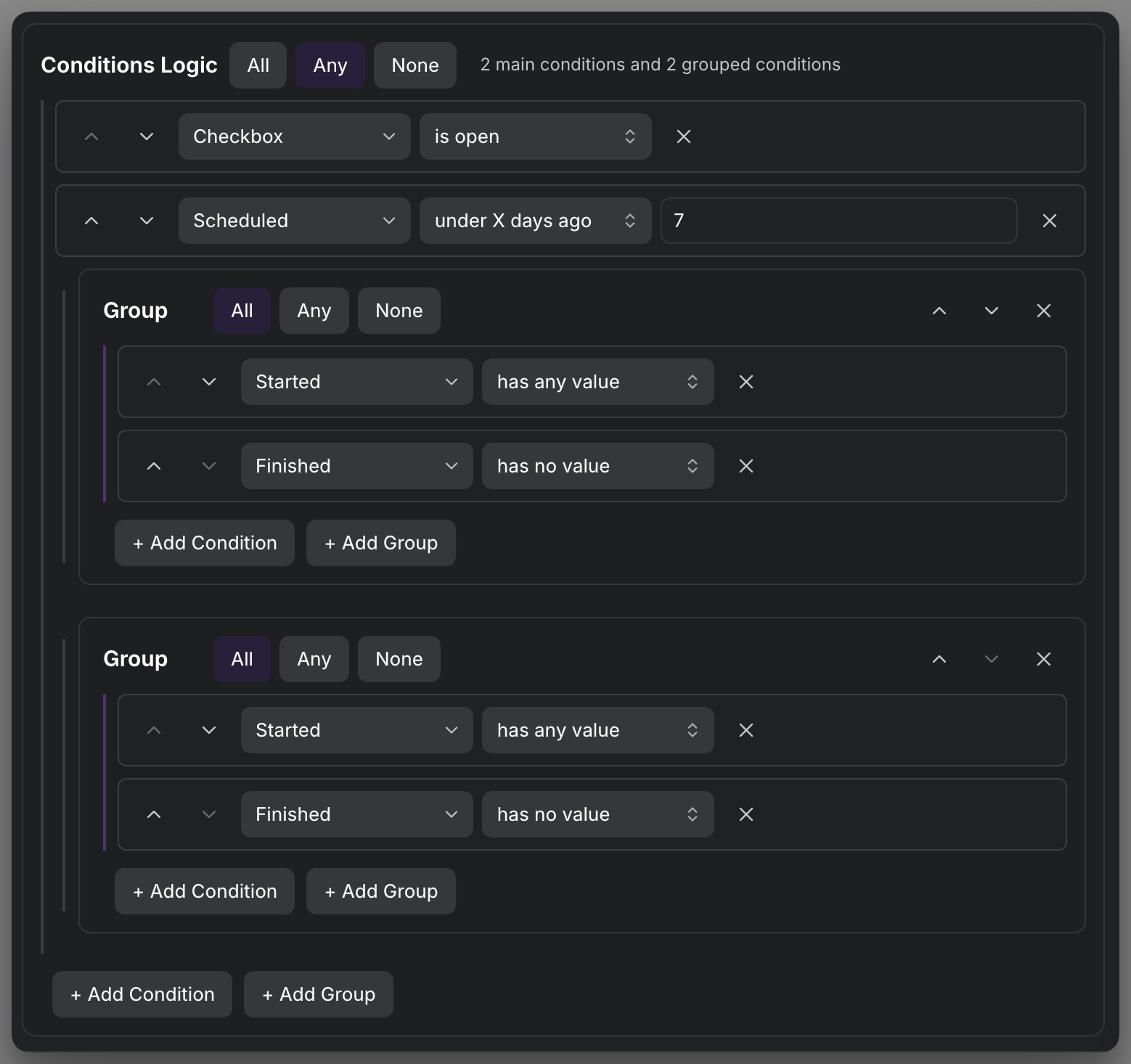
Groups can be nested: a group can hold other groups, so you can express "status is active AND (due this week OR priority is high)." This is how a filter goes from a flat list to a precise query.
MEDIA-DOCS-073-2: A nested filter with an "all" group containing an "any" subgroup.
Operators by property type
The operator list is chosen by the field's type. These are the full sets.
Text
For text fields like the title or a text custom key:
contains, does not contain, is, is not, starts with, ends with, has any value, has no value, property is present, property is missing.
Number
For number fields like estimate:
equals, does not equal, less than, more than, not less than, not more than, divisible by, not divisible by, has any value, has no value, property is present, property is missing.
Date and Date & time
For date fields like dateDue and dateScheduled (date and time fields use the same set):
date is, before, after, is today, not today, before today, after today, exactly X days ago, exactly X days away, under X days ago, under X days away, over X days ago, over X days away, this week, last week, next week, this month, last month, next month, day of week is, day of week is not, month is, month is not, has any value, has no value.
The "X days" operators take a number, and "day of week is" and "month is" take a weekday or month number, so their input is numeric rather than a date picker.
When a task Date or Date & time condition opens the date picker, its selected date and suggestion dates follow Settings → Operon → General → Date format. The filter still stores and compares the canonical value, so changing the display preference does not change which tasks match. Natural-language input and the picker itself are covered in Date and time picker.
List and tags
For list fields like assignees, contexts, links, and tags:
any item contains, any item starts with, any item ends with, no item contains, no item starts with, no item ends with, all items are, all items contain, count is, count is not, count less than, count more than, has any value, has no value.
The count operators test how many entries the list has, which is useful for "has more than one assignee."
Checkbox
For a task's open or closed state: is open, is done, is cancelled.
File task property operators
A file task property gets its operators from the same type-based lists above, with two differences that matter because a discovered property is not a field every task structurally has:
- Checkbox is a real boolean here, not a task's open/closed state. A file task property typed Checkbox uses
is true,is false,has any value,has no value,property is present,property is missing, not theis open/is done/is cancelledset built-in Checkbox fields use. - Date, Date & time, List, and Tags gain
property is presentandproperty is missing. A built-in date or list field does not need these, every task has that slot, but a discovered property may not exist on a given note's frontmatter at all, so these two operators let a condition tell "missing" apart from "present but empty." - Text and Number use exactly the same operator lists as their built-in counterparts, since those already include
property is presentandproperty is missing.
Structural conditions
A few conditions test a task's place in the system rather than a single field value:
- Pinned:
is pinned, true for tasks on the dock. - Task tree:
matches task tree, for filtering by a task's parent or subtask relationship. See Parent and sub-tasks. - Folder:
is in folder tree, true when the task's file sits inside a chosen folder. - Project Serial Group: filters by a task's project serial group, the prefix its serial carries. Use
has any project serial grouporhas no project serial groupto separate tasks that hold a serial from those that do not;is any oforis none ofto pick specific groups from a searchable list, which also offers to select every group starting with a prefix; orstarts withanddoes not start withto match groups by a prefix you type.
These let a filter say "anything under this project," "only pinned work," or "only tasks in the DOCS serial group," not just field comparisons.
FAQ
Why are some operators missing for my field? The list is chosen by the field's property type. Change the field's type and the available operators change with it.
How do I express OR? Put the alternatives in an "any" group. Combine with an outer "all" group for AND plus OR together.
Why did the value box disappear? The operator you chose needs no value, like "is today" or "has any value."
Why does a Checkbox condition on a frontmatter property say "is true" instead of "is open"? It is a file task property, a real boolean, not the task's own open or closed state, so it gets is true / is false plus presence operators instead.