Pinned Task Dock
The Pinned Task Dock keeps a chosen set of tasks always in view, so the work you care about most stays one glance away while you move around the vault. It is a small, persistent surface for "the few things I am actually on right now." You can pin inline tasks and file tasks together on the same dock, so your focus list is not split by how each task is written.
MEDIA-DOCS-032-1: Pinned tasks shown in the side panel.
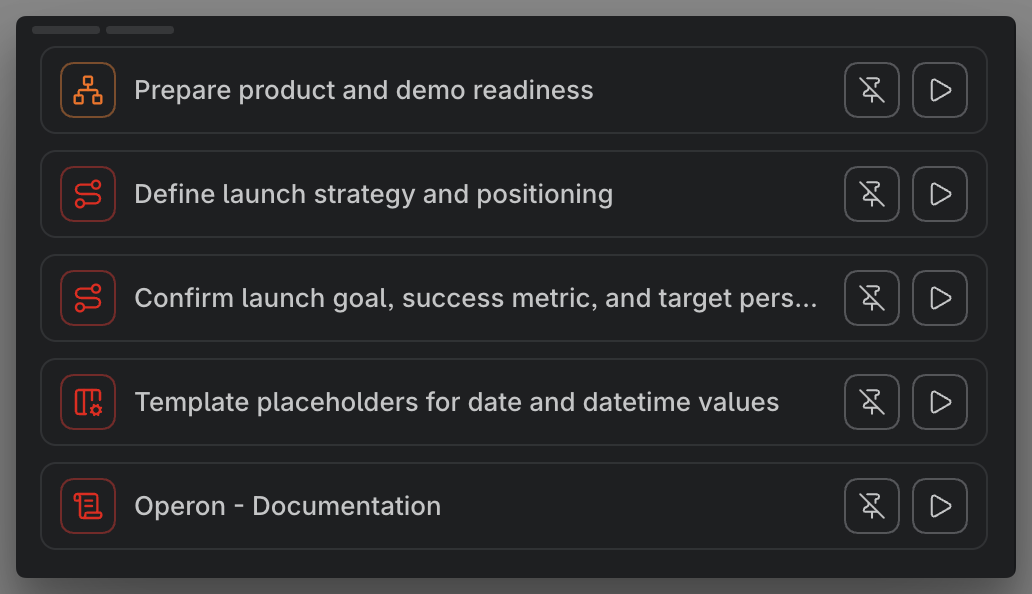
Pin a task
Pin a task from its contextual menu with Pin task, and remove it later with Unpin task. Pinned tasks stay on the dock across notes and sessions until you unpin them.
Pinning automatically when a reminder arrives
A task can also arrive on the dock on its own. Turn on Pin task when its reminder time arrives, in Settings → Operon → Tasks → Reminders, and Operon pins a task as it processes one of that task's due reminders. It is off by default.
This turns a reminder from a moment into a state. A plain reminder tells you once and is gone; with this on, the task also lands on the dock and stays there until you unpin it, which suits a nudge that means "this now needs to stay in front of me."
It only ever pins open tasks, and never pins a task that is already pinned, so a task with several reminders does not accumulate anything. Unpinning is always yours to do; Operon does not unpin automatically when the reminder passes. See Reminders.
Two surfaces: floating dock or side panel
You can show your pinned tasks in either of two places:
- A floating dock over your notes. Toggle it with Toggle Pinned Tasks dock.
- A side panel, like a normal Obsidian sidebar view. Open it with Open Pinned Tasks.
Which one you get is a setting. In Settings → Operon, the pinned-tasks surface can be set to the dock or the sidebar, and when you use the sidebar you can choose the left or right side. On smaller screens the sidebar can be the more comfortable choice.
Acting on pinned tasks
The dock is not just a list. Each pinned task offers the same contextual menu as anywhere else, so you can open the Task Editor, change status, start a timer, or mark it done without leaving what you are doing. See Contextual menu actions.
Separately from that menu, each row also carries its own Unpin and timer icons directly on it. On desktop, these stay out of the way until you hover the row or reach it with the keyboard, so the task's description gets the full row width the rest of the time. On mobile, where there is no hover, the same icons stay visible all the time instead.
Click a pinned task to open it in the Task Editor. Hold Cmd (macOS) or Ctrl (Windows and Linux) and click to open the task's source in a new Obsidian tab instead: the note for a file task, or the exact line for an inline task, the same convention as opening a link in a new browser tab.
FAQ
Do pinned tasks stay after I close Obsidian? Yes. Pins persist until you unpin them.
Can I move it to the sidebar? Yes. Set the pinned-tasks surface to the sidebar in settings, and pick the left or right side.
Is pinning the same as priority? No. Pinning is a personal "keep this in front of me" choice. Priority is a task field used for sorting and filtering. See Task priorities.
A task pinned itself. Why? You have Pin task when its reminder time arrives turned on and one of that task's reminders came due. See Reminders.
Does an auto-pinned task unpin itself later? No. Once pinned, it stays until you unpin it.
Settings
Operon settings for this live in Settings → Operon → Interface → Pinned Dock, which configures the pinned tasks surface, floating dock or sidebar. The Pin task when its reminder time arrives automation is set separately, in Settings → Operon → Tasks → Reminders.