Task Editor
The Task Editor is where you view and change a task's structured fields without editing Markdown by hand. It works the same for inline and file tasks, because both are the same kind of task record underneath.
MEDIA-DOCS-021-1: The Task Editor open on a task, showing its fields and, for a file task, the Markdown body.

How to open it
- On an existing inline task, run Create or edit inline task.
- On a file task or a note with task fields, run Edit or convert to file task.
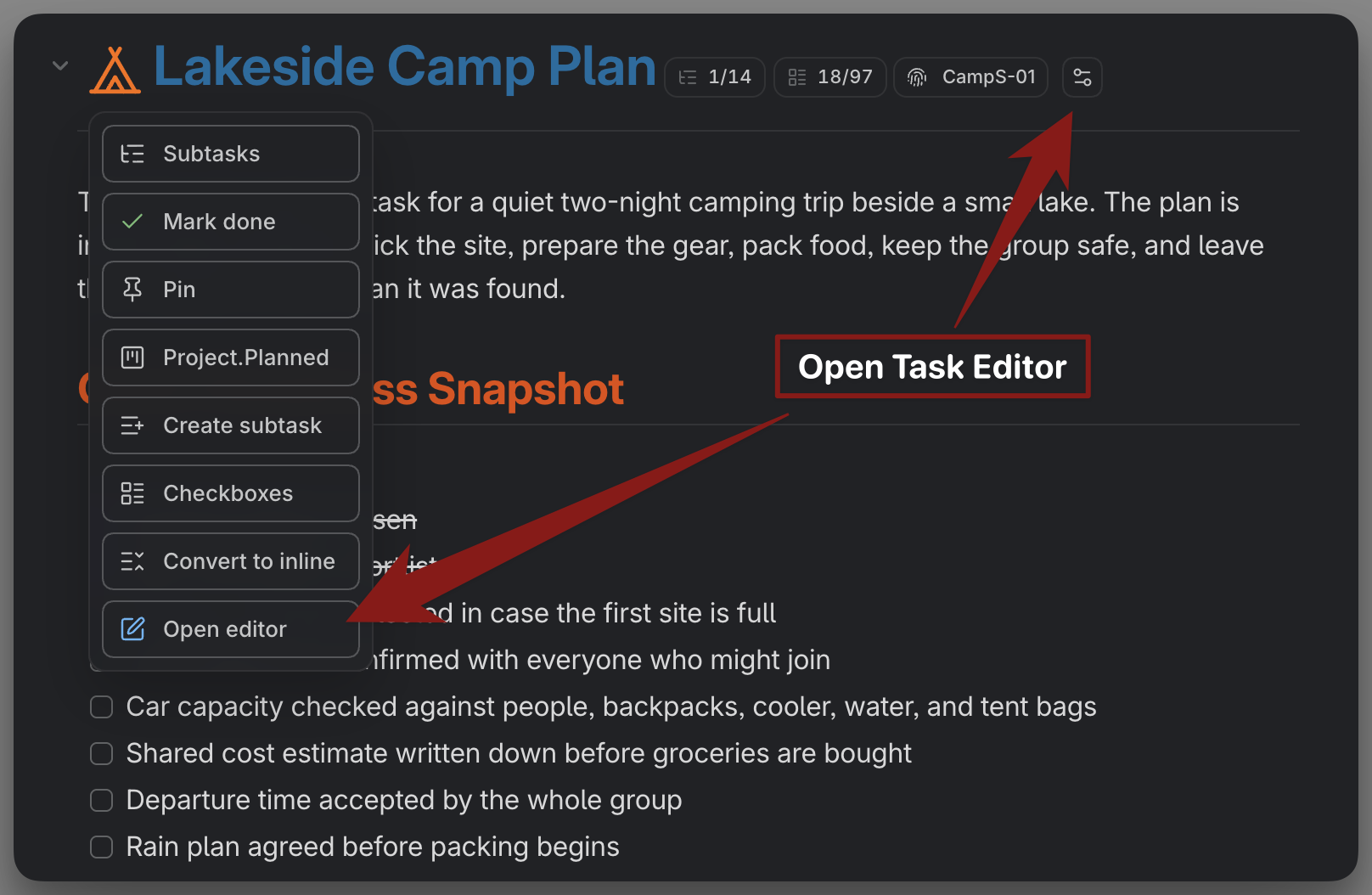
- From any Operon surface, open a task's contextual menu and choose Open editor. See Contextual menu actions.
From a Canvas Task Card, select the card and use Open editor, or choose it from the task icon's contextual menu. From an Embedded Task Card in a note, click the task title.
The same command that creates an inline task also edits one, so the editor is never more than a keystroke away from the task.
MEDIA-DOCS-021-2: Opening the Task Editor from a task's contextual menu with Open editor.
What you can change
The Task Editor exposes the canonical fields as proper controls:
- Status and priority.
- Dates: due, scheduled, started, and timed start/end blocks.
- Parent task and dependencies.
- Recurrence. See Recurring tasks.
- Reminders, both kinds. See Reminders.
- Pinning. See Pinned Task Dock.
- Time tracking, including session history. See Time tracking.
- Icon, color, and a Note that can contain multiple lines.
- Task Type as a user-managed Text classification.
- Task Image as one media reference and Task Gallery as an ordered list. See Task images and galleries.
For a file task, the editor can also show the Markdown body alongside the fields, so you edit the work and its metadata together. For an inline task, it can reveal the source note when you need the surrounding context. It can also Show checkboxes for the task's plain checklist.
The editor's Date and Date & time controls follow Settings → Operon → General → Date format for their visible date part, while timed values also follow the separate Time format setting. This does not change the value passed to the picker or written back to Markdown; task dates remain canonical ISO values. See Date and time picker.
MEDIA-DOCS-021-3: The Task Editor on a file task, the fields beside the Markdown body.

Copy a task wikilink
Use Copy task wikilink, the file-box button at the left of the header's copy controls, to copy a link to the current task. Paste it wherever you want to refer to that task. It copies a link, not a new task or a Task Card embed.
A File Task uses a normal note link. An Inline Task adds its Operon ID to the source note's name, using the Task Wikilink Overlay link format:
[[Project plan]]
[[Daily notes#-abc1234]]
The first example links to a File Task named Project plan. The second links to the inline task with ID abc1234 in Daily notes. Operon copies the current task's actual note name and ID for you.
Copy a task card into a note
Use Copy task card embed, beside Copy operonId, to copy a ready-to-paste block for the current task. Paste it into a note to display an interactive card in Live Preview and Reading view. The block includes the existing task ID and current card layout options; it does not create another task.
The task must be indexed with a valid, unique ID. The original Copy operonId control still copies only the ID. For local width, alignment, text wrapping, and visibility options, see Embedded Task Cards.
Parent and subtask cards
When a task has a parent, its own direct subtasks, or both, the editor shows them as small cards near the top, above the fields, so you can see the immediate family without leaving the task you opened. See Parent and sub-tasks.
- A parent card is navigation only. Click it to open the parent's own editor; there is nothing to complete from here.
- A subtask card for an open subtask offers a complete action on hover or keyboard focus, so you can check off a direct subtask without leaving the parent task's editor. A finished or cancelled subtask's card has no such action.
Date chips shown on these parent and subtask cards use the same General Date format as the editor fields. Their urgency color and the task data behind them still use the original canonical date, so changing the display format does not change scheduling or date comparisons.
This shows only direct parent and children. For a task's whole subtree, run Subtasks from its contextual menu to open the Dynamic Subtasks Filter instead.
Remove a task without broken relationships
The Task Editor's Remove action deletes the selected task and cleans references to it as one guarded operation. The confirmation names how many surviving direct subtasks will become root tasks before you continue.
- Each surviving direct child's
parentTaskfield is cleared; the child's other fields and identity stay unchanged. - A grandchild remains attached to its own direct parent, so only the deleted level of the tree is detached.
- Surviving tasks remove the deleted id from their Blocking and Blocked By fields.
- Removing an inline task leaves its source line empty. Removing a file task uses Obsidian's trash behavior; tasks that disappear with that file do not need a separate relationship rewrite.
Operon stops before deleting anything when it cannot safely match the current task and affected sources, including duplicate identities or changes made after the confirmation was prepared. Review the task and try again after resolving the conflict rather than expecting a partial cleanup.
Reminder rows
Reminders get their own rows, one for ReminderDatetimes and one for ReminderRules, and they behave a little differently from a single-value field. Each reminder on the task appears as its own chip in the row, so a task with three reminders shows three chips rather than one crowded value.
- Add one from the row's own control, which opens the picker for that kind of reminder.
- Edit or remove one by clicking its chip, which reopens the same picker loaded with that reminder.
- The ReminderRules control is disabled when the task has no date a rule could attach to, since there would be nothing for an offset to count back from. Give the task a due, scheduled, or start date, or a timed block, and it becomes available.
Both rows are hidden by default. Turn them on in Settings → Operon → Interface → Task Editor, under Workflow Pickers, which is also where you set the order of the editor's picker rows. Hiding a row never changes the reminders stored on a task. See Reminders.
Saving is automatic
The Task Editor autosaves your changes two seconds after your last edit, so you do not press a save button while working through a task's fields. Closing the editor, with its close control, a keyboard shortcut, or the backdrop, saves any pending change immediately rather than waiting out that two seconds. This timing is fixed and not a setting.
Description and Notes
The Description is the task's one-line title. Notes are a separate multiline field for the detail that belongs with the task but does not belong in its title. In the Notes control, use Shift+Enter to insert a line break; pasted multiline text and intentional blank lines are kept. Normal Enter keeps the existing action for the surface instead of becoming a second line-break command. In the mobile Task Editor, normal Enter keeps its one-line behavior by inserting a space, while Shift+Enter inserts a note line break.
For an inline task, those visual line breaks are stored as \n escapes inside the note field, keeping the entire task on one physical Markdown line. A literal \n is written as \\n. See Inline task syntax for the on-disk form and Text field editor popover for the shared compact editor.
Why edit here instead of in Markdown
You can always edit the raw {{key:: value}} text, and Operon will read it. But the Task Editor is safer: it writes fields in the right format, keeps operonId intact, and updates rollups and links for you. Hand-editing is best for quick text tweaks; the editor is best for anything structural. See Task identity and operonId.
FAQ
Is the editor different for inline and file tasks? The fields are the same. File tasks additionally show the note body; inline tasks can jump to their source line.
Will editing here change my Markdown? Yes. The Task Editor writes back to the task's Markdown, inline line or file frontmatter, so your notes stay the source of truth.
Do I need to save before closing the Task Editor? No. It autosaves two seconds after your last edit, and closing it saves any pending change right away.
Why can I not add a reminder rule to this task? A rule counts back from one of the task's dates, and this task has none yet. Add a due, scheduled, or start date, or a timed block, first.
I do not see reminder rows in the editor. They are hidden by default. Turn them on under Settings → Operon → Interface → Task Editor, in Workflow Pickers.
Can I write a multiline description? No. The Description remains the task's one-line title. Use Notes for line breaks, paragraphs, and pasted multiline detail.
What happens to children and dependencies when I remove a task? Surviving direct children become root tasks, deeper descendants stay linked to their own direct parent, and surviving Blocking and Blocked By fields drop the deleted id.
Settings
Operon settings for this live in Settings → Operon → Interface → Task Editor, which configures the Task Editor layout and which fields it shows.