Contextual menu actions
Wherever a task appears, Operon offers a contextual menu of actions on it: from a filter row, a Calendar item, a Kanban card, a pinned task, an Upcoming Tasks card, a Canvas Task Card, an Embedded Task Card, or an inline task. Task icons also expose contextual hover menus across supported surfaces, including Calendar and the task icon column in the Table. It is the mouse-friendly counterpart to the command palette.
The menu is context-aware: an action only appears when the current task and surface actually support it. A scheduled task offers Unschedule; a recurring occurrence offers Skip this occurrence; a task with no due date will not show Clear due date; the Subtasks action shows only on an open task that actually has subtasks.
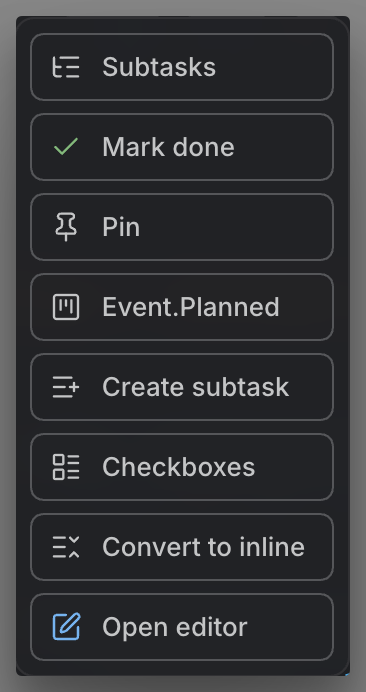
MEDIA-DOCS-042-1: A task's contextual menu open, showing the available actions.
The actions
Grouped by what they do:
- Open and inspect: Open editor, Jump to source (go to the task's note), Copy operonId.
- Status and completion: Task status, Mark done, Cancel task.
- Structure: Subtasks (open the task's Dynamic Subtasks Filter, a live filtered window of just this task's subtree, locked to its
operonId; appears only on an open task that has subtasks), Create subtask, Checkboxes (open or create plain checkboxes). See Dynamic Subtasks Filter. - Convert: Convert to file, Convert to inline. See Converting inline and file tasks.
- Scheduling: Unschedule, Clear due date, Skip this occurrence.
- Pin and time: Pin task / Unpin task, Start timer / Stop timer, Log as tracked (record a planned block as tracked time).
- Reminders: Fixed Reminder opens the ReminderDatetimes picker, Relative Reminder opens the ReminderRules picker, each icon following its own canonical property. See Reminders.
- Remove: Delete task.
Settings
You control the menu in Settings → Operon → Interface → Context Menu:
- Contextual Menu Actions: choose which actions are globally enabled and set their order. Disabled actions never appear; enabled ones still show only when the task and surface support them.
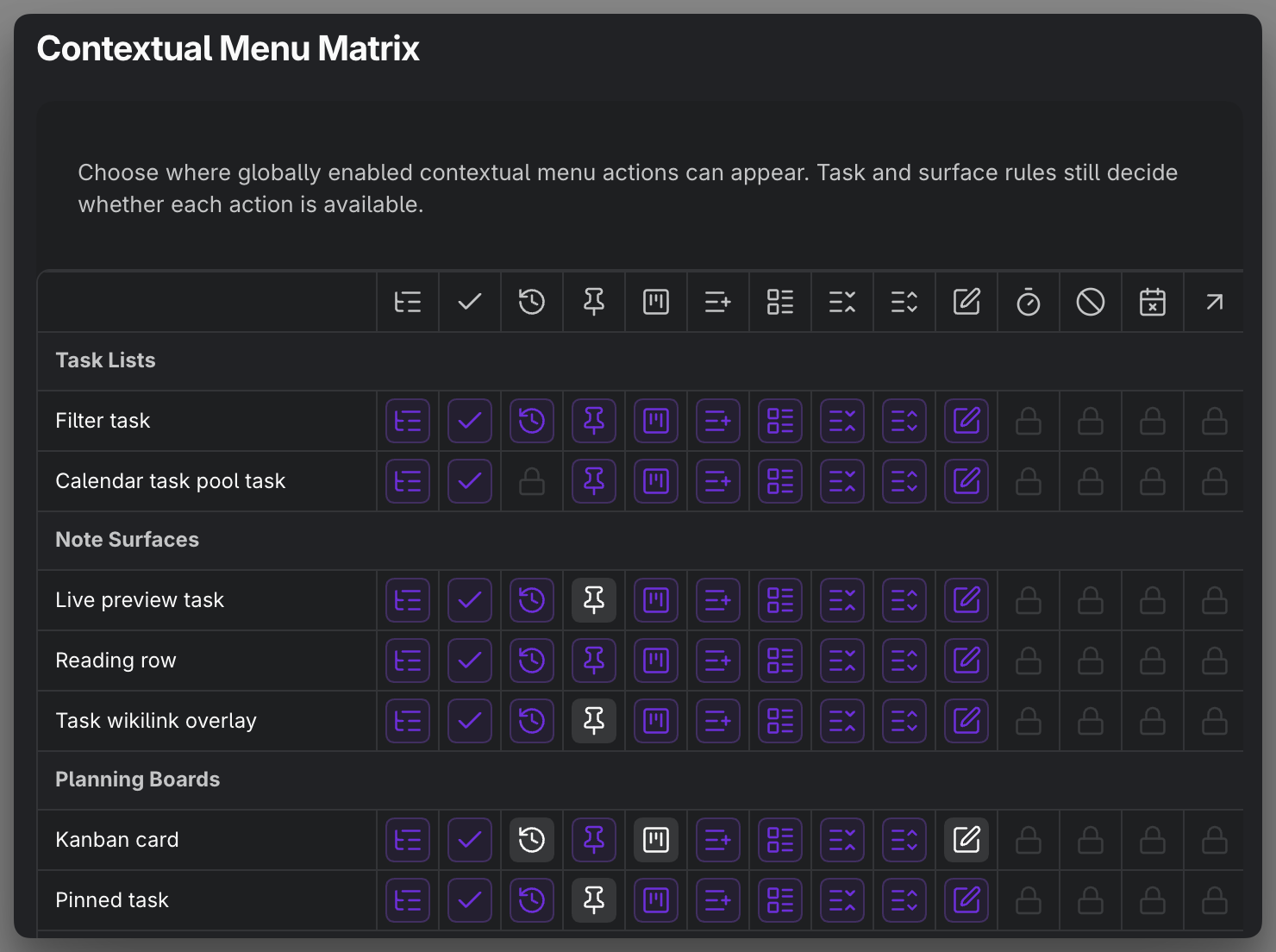
- Contextual Menu Matrix: choose which surfaces can show each globally enabled action. The Upcoming Tasks row is under Task Lists, so its menu can be configured independently of other task surfaces. Task wikilink overlay has its own row under Note Surfaces. The Task Cards row controls the task-icon menus shared by Canvas Task Cards and Embedded Task Cards, independently of Kanban and other task surfaces. Locked cells mean the action is globally disabled or unsupported on that surface; enabling a cell never overrides task-specific availability.
- Context Menu Delay: set the Hover menu open delay.
- Mobile touch menu: enable long-press menus and adjust the long-press delay and transition grace period.
Tune this once to keep the menu short and relevant to how you work.
MEDIA-DOCS-042-2: The Context Menu settings, enabling actions and setting their order.
Interacting with an open menu
Clicking a task icon follows the global Task icon click action preference; choosing an explicit menu action such as Cancel task keeps that action’s own meaning. See State Icons for the two icon modes.
When a task’s status or state changes and the task remains on the same surface, the hover menu stays open and updates its available actions in place rather than closing and reopening during the save. If the task disappears from that surface—for example, a completed task is removed from a filtered list—the menu can close. This keeps the menu attached to the task you were using.
On mobile, enable Mobile touch menu to open the menu with a long press. Releasing that press does not also activate the task icon. A short tap keeps the icon’s normal click behavior.
Task Card menus
Hover over a Task Card's task icon to open its contextual menu. With the icon focused, the Context Menu key or Shift+F10 also opens it. Use Open editor, Jump to source, or another available action without leaving the card's task context.
Menu actions operate on the source task. On Canvas, they respect the Canvas read-only state; enabling an action in the matrix does not bypass that lock or make an unavailable task editable. The separate Task Card Actions settings control the card's inline buttons, not this menu.
The relationship controls on a selected Canvas connection are separate again: they set parent–child and blocking relationships between the connected tasks. See Canvas Task Cards for those controls.
FAQ
Why do I see different actions on different tasks? The menu is context-aware. It hides actions that do not apply to the current task or the surface you are on.
Can I reorder the actions? Yes, in the Context Menu settings. Order and visibility are both yours to set.