Task chips: display and behavior
A task chip is a small badge that shows one of a task's fields at a glance: its priority, its due date, its assignees. Chips are how a task wears its metadata where you see it, without opening the task. This page covers both halves of that: what chips show and where, and how each one behaves when you click or hover it, because a chip is not just a label, it is a control.
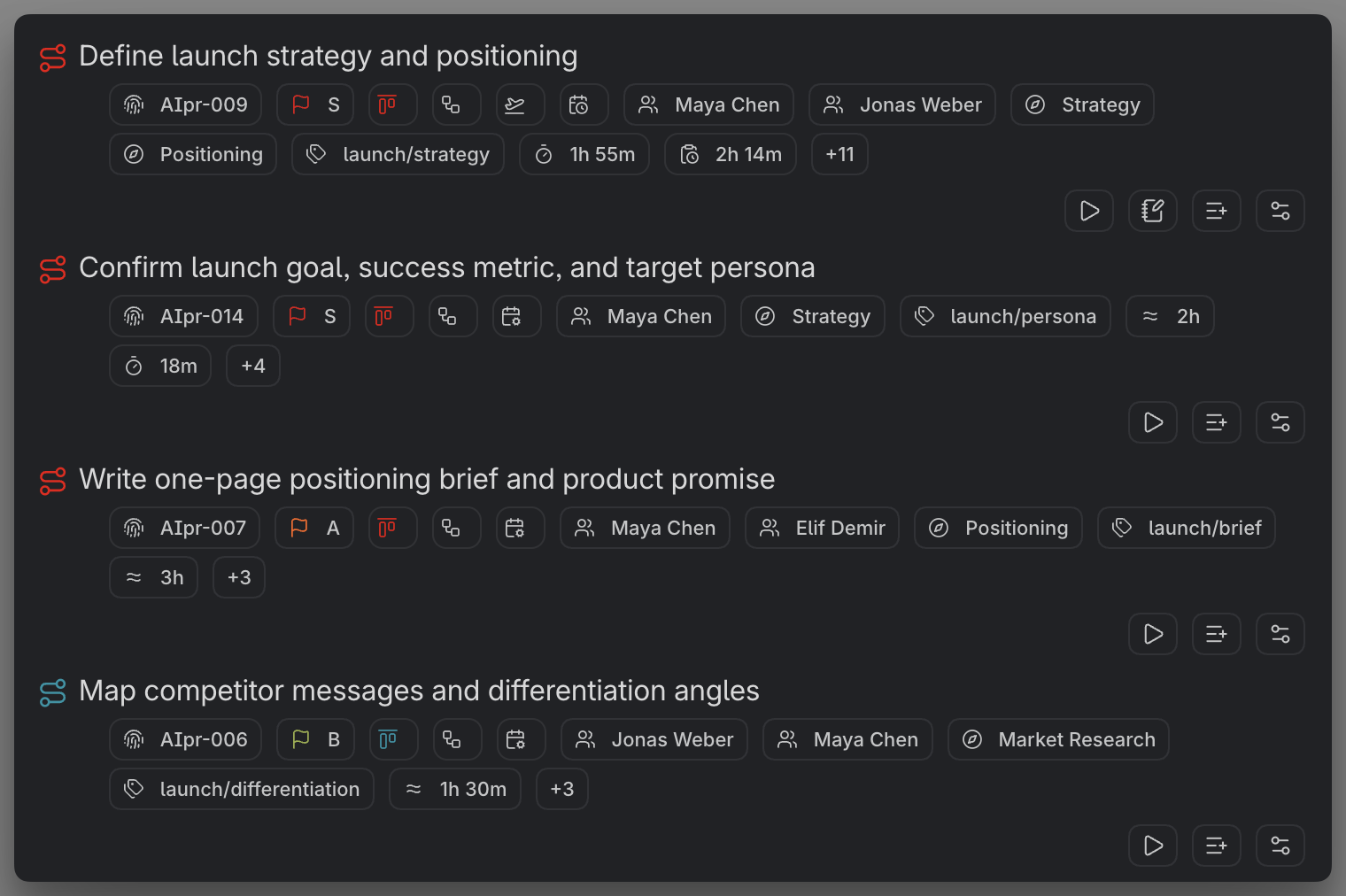
MEDIA-DOCS-041-1: A task displaying several chips: status, priority, due date, and assignees.
What chips can show
Chips cover the fields you most often want at a glance:
- Status and Priority.
- Dates: Due, Scheduled, Start, and the completion and cancellation dates.
- Assignees and Contexts.
- Task links: Parent, Blocking, and Blocked by.
- Estimate and Duration, and their rolled-up totals.
- Recurrence, showing a recurring task's pattern (the
repeatfield). - Reminders, one chip per reminder, from either reminder field. See Reminders.
- Location, shown as a small map chip.
- Tags and external Links.
- Task Type, a user-managed task classification.
- Task Image and Task Gallery, as one or several media-reference chips. See Task images and galleries.
Your own custom keys can appear as chips too, when you turn on "Show in chips" for them, so the row can carry exactly the fields your workflow cares about.
Each surface is configured separately
Chips follow a task across several surfaces, and each surface has its own chip configuration: which chips show, in what order, and whether any is Icon Only. So a busy Filter View can carry a shorter set than an inline row, arranged differently. The six surfaces, each with its own settings page under Settings → Operon → Interface → Task Chips, are:
-
Inline Task Chips: the compact chip row on inline tasks in Live Preview and reading view.
-
Filter Task Chips: the chips on rows in the Filter View.
-
Task Finder Chips: the chips in Task Finder results.
-
Kanban Task Chips: the chips on main cards in the Kanban.
-
Task Wikilink Overlay Chips: the chips on a task wikilink overlay, which now decorates both file-task links and inline links written as
[[File#-operonId]]. See Task Wikilink Overlay. -
Task Card Chips: the shared chip configuration for Canvas Task Cards and Embedded Task Cards in notes.
Because each is independent, you tune the chip row per place rather than once for everything.
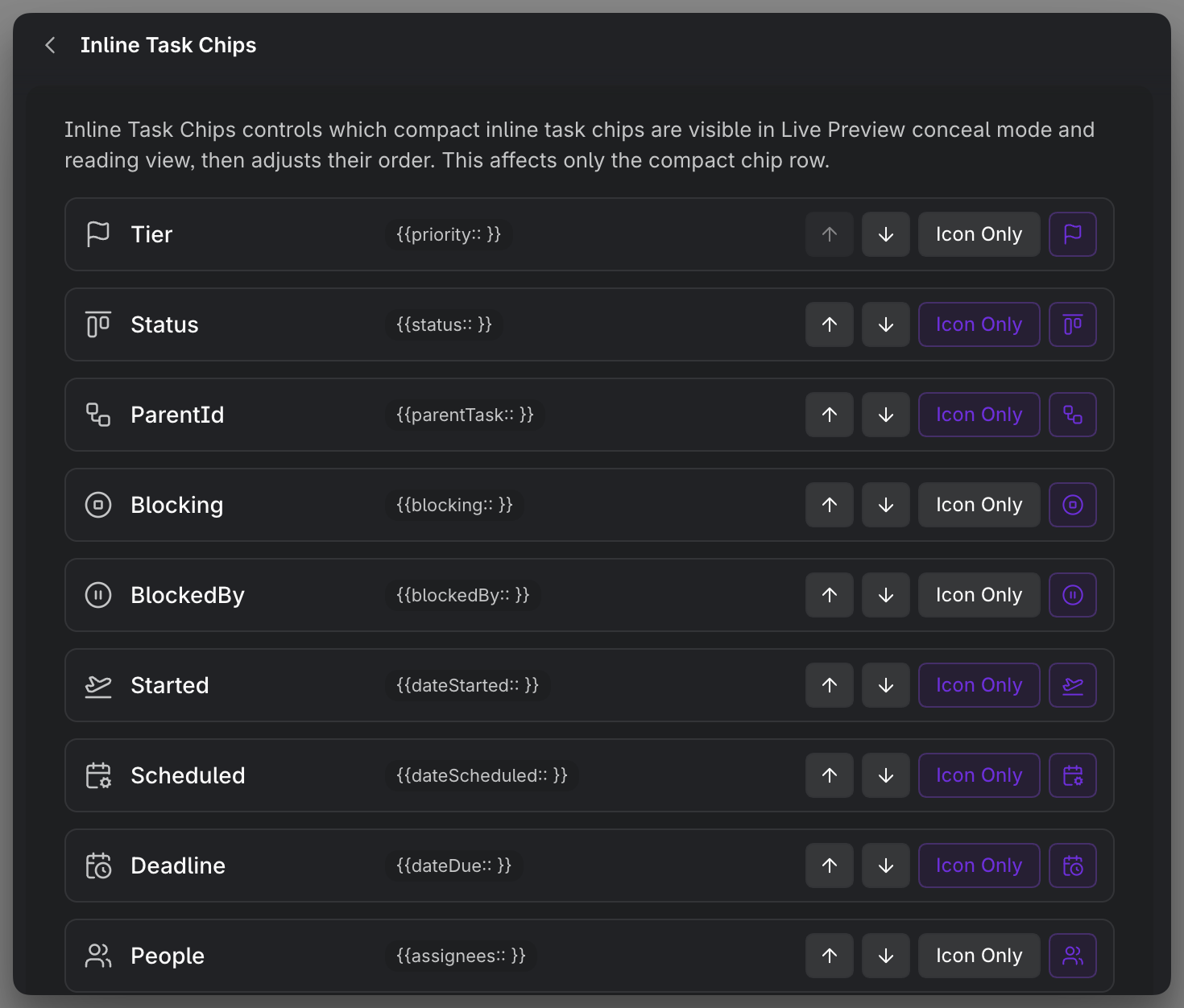
MEDIA-DOCS-041-2: The Task Chips settings for one surface, toggling visibility, reordering chips, and setting Icon Only.
Showing, hiding, and Icon Only
For each chip on each surface you can turn its visibility on or off, and set it to Icon Only, which drops the text and shows just the icon, a tidy way to keep a busy row compact while still signalling the field. On interactive surfaces, an Icon Only chip can show a small preview of its full content when you click it, so nothing is lost by hiding the text.
Assignee images
An assignee linked to a person note can show an image in place of the usual assignees icon. Open Settings → Operon → Interface → Task Chips → General Chip Settings, at the bottom of the Task Chips list, and enter the property name in Assignee image property. You can type any name or choose a suggestion from the vault's property names. Leave it blank to keep the usual icons.
The image comes from that property in the linked person's note, not from an upload to Operon. For example, assign [[Bobby]] and give Bobby's note a photo property containing an image reference. Plain Bobby text does not resolve a person note. Missing or unreadable images keep the usual icon, and the person's name and click behavior stay the same. See How to show assignee images for the setup and supported values.
Date and time on chips
Built-in and custom task fields typed as Date follow Settings → Operon → General → Date format. The same choice is used on Inline Task Chips, Filter Task Chips, Task Finder Chips, Kanban Task Chips, Task Wikilink Overlay Chips, and Task Card Chips, so a date keeps the same visible order as the task moves between surfaces.
A Date & time chip stays compact by showing only its time in the row. Its tooltip shows the complete value: the date follows Date format, and the time follows the separate 12-hour or 24-hour Time format setting. These are display choices only; the chip still opens and writes the task's canonical date or datetime value.
Kanban card chips
Kanban cards use the Kanban Task Chips surface. On desktop, Kanban chips behave like the same chips elsewhere: editable chips open their pickers, link-like chips open or preview their target, and location chips open the map popover. A card only shows the chips you chose to display, with nothing standing in for the ones you hid.
The end of the Kanban Task Chips page also has Kanban Task Actions. These control the trailing action chips on Kanban cards, such as Play, Pin, Note, Add subtask, and Open checkboxes. When the Play action is enabled, it turns into Stop while that task's timer is running.
On mobile Kanban, the same chip area stays visible but read-only. Tapping chips or action chips does not open pickers, links, previews, map popovers, or actions, so card tap, scroll, and long-press drag remain the main touch gestures. If a task has a Project Serial, that serial appears first on the main Kanban card as a display-only identity chip, even though Project Serial is not controlled by the Kanban Task Chips settings list. Descendant preview cards do not show chip rows.
Task Card chips and actions
Canvas Task Cards and Embedded Task Cards share Task Card Chips. Their field visibility, order, and Icon Only choices are independent of Inline, Filter, Task Finder, Kanban, and Task Wikilink Overlay chips. Editing a field through a card updates the same source task shown in those other surfaces.
The Task Card Actions controls on that settings page choose whether cards offer Play, Pin, Note, Add subtask, and Open checkboxes. Play becomes Stop while the task is being timed; each action appears only when enabled and applicable. These controls are separate from the task icon's contextual menu configuration.
The whole chip section can also be shown or hidden under Settings → Operon → Views → Task Cards. A note embed may override that section's visibility with chips: true or chips: false; it still uses the same configured field list. Images and progress are separate card sections, so hiding chips does not hide those sections.
On a locked Canvas, task-changing card controls are unavailable. The mobile Kanban restriction described above belongs to Kanban cards; it is not the setting for Canvas or embedded Task Cards. For card layout and interaction details, see Canvas Task Cards and Embedded Task Cards.
How a chip behaves when you click it
On interactive surfaces, clicking a chip does something specific to its field. Some chips are quick editors, and some are navigators:
| Chip | Clicking it |
|---|---|
| Status | Cycles the task's status |
| Priority | Opens the priority picker |
| Due, Scheduled, Start, and the other dates | Opens the date picker |
| Estimate | Opens the estimate picker |
| Recurrence | Opens the recurrence picker |
| Reminder | Reopens that reminder's picker, to change or remove it |
| Assignees, Contexts, Parent, Blocking, Blocked by | Opens the linked task or note, creating it if it does not exist yet |
| Tags | Opens Obsidian's tag search for that tag |
| Links | On desktop, opens the web link in a lightbox; Cmd/Ctrl-click opens a Web Viewer tab |
| Location | Opens the map popover (see below) |
| Task Image, Task Gallery | Opens a supported local file or external URL; hovering previews supported images, videos, PDFs, and YouTube links |
So status, priority, dates, estimate, and repeat let you change the value on the spot, while the link, tag, and location chips take you somewhere.
Web links in a lightbox
On desktop, an interactive Links chip opens its web page in an Operon lightbox. Obsidian's core Web Viewer plugin must be enabled. The viewer keeps its own address bar and navigation controls, so you can browse before closing the lightbox with ×. Escape may not close it while focus is inside the web page.
Hold Cmd on macOS or Ctrl on Windows/Linux while clicking to open a new Web Viewer tab instead. Enter or Space on a focused chip opens the lightbox; right-click keeps the existing context menu. If Web Viewer is unavailable, Operon shows a short notice rather than redirecting to a browser.
This applies to the task's Links field, not ordinary Markdown links or custom fields. Mobile behavior and existing media previews stay unchanged. Detailed Table cells distinguish a link chip from the editable space around it; see Table cells: display and behavior.
Task media preview and lightbox
Plain-hover a Task Image or Task Gallery chip to inspect its media without leaving the task. Local and web images, videos, PDFs, and supported YouTube links use the same compact Operon preview width. A named Markdown link shows its assigned label on the chip and in the preview header while keeping its media target intact.
Every media preview uses a full-width header with a left-aligned open control and a centered title. Click anywhere on that header to open a centered, near-fullscreen lightbox. Images also keep double-click opening and their zoom and pan controls; videos retain playback controls, PDFs open in a scrollable viewer, and YouTube uses a privacy-enhanced player without autoplay. Close the lightbox with Escape, its close control, or the backdrop. The lightbox is for viewing only; it does not edit the field or gallery order. See Task images and galleries.
Wikilink chips: open and preview
The task-link chips (Assignees, Contexts, Parent, Blocking, Blocked by) and any custom list or text chip whose value is a wikilink point at a note. Two behaviors follow:
- Click the chip to open that note. This is create or open: if the linked note already exists, it opens; if it does not exist yet, Obsidian creates it and opens the new note, the same as clicking any wikilink.
- Cmd or Ctrl and hover the chip to get Page Preview, the same hover preview you get on any internal link. This requires Obsidian's core Page Preview plugin to be enabled (Settings, Core plugins, Page preview). A plain hover does not trigger it; the modifier key does.
Date chips change color
The Due and Scheduled chips signal urgency by color, so a glance tells you what is pressing:
- Overdue (the date is before today): the chip turns red.
- Today (the date is today): the chip turns blue.
- Otherwise it stays neutral.
Once a task is finished or cancelled, its date chips drop the color, because the deadline no longer presses. Only Due and Scheduled take these colors; the other date chips stay neutral.
The recurrence chip
A recurring task shows a recurrence chip (from its repeat field) that summarizes the pattern: the recurrence rule, or the next occurrence date, or that the next run comes after completion, along with an end if the series has one. You read the rhythm at a glance, and clicking the chip opens the recurrence picker to change it. See Recurring tasks.
Reminder chips
Reminders differ from every other field here in two ways.
One chip per reminder, not per field. A task with two fixed reminders and a rule shows three chips, each carrying its own value, rather than one chip holding a list. Clicking a chip reopens that reminder's own picker so you can change or remove it. A fixed reminder shows just the time when it falls today and the date with the time otherwise; a rule shows itself in words, as 1d before Due date.
They are hidden by default on every surface. Most tasks carry no reminders, so the chips stay off until you ask for them, on each surface separately like any other chip. Turning them off is purely visual: the reminders stay on the task and keep firing regardless.
A chip also carries the reminder's state, which is how you spot one that will not fire:
| State | What it means |
|---|---|
| Normal | Scheduled, still ahead |
| Past reminder | Its moment has gone by |
| Unresolved reminder | A rule whose reference date is missing, so nothing is scheduled |
| Invalid reminder | The stored value could not be read |
See Reminders for what the two reminder fields are, and Reminder rules for how a rule resolves.
The location chip
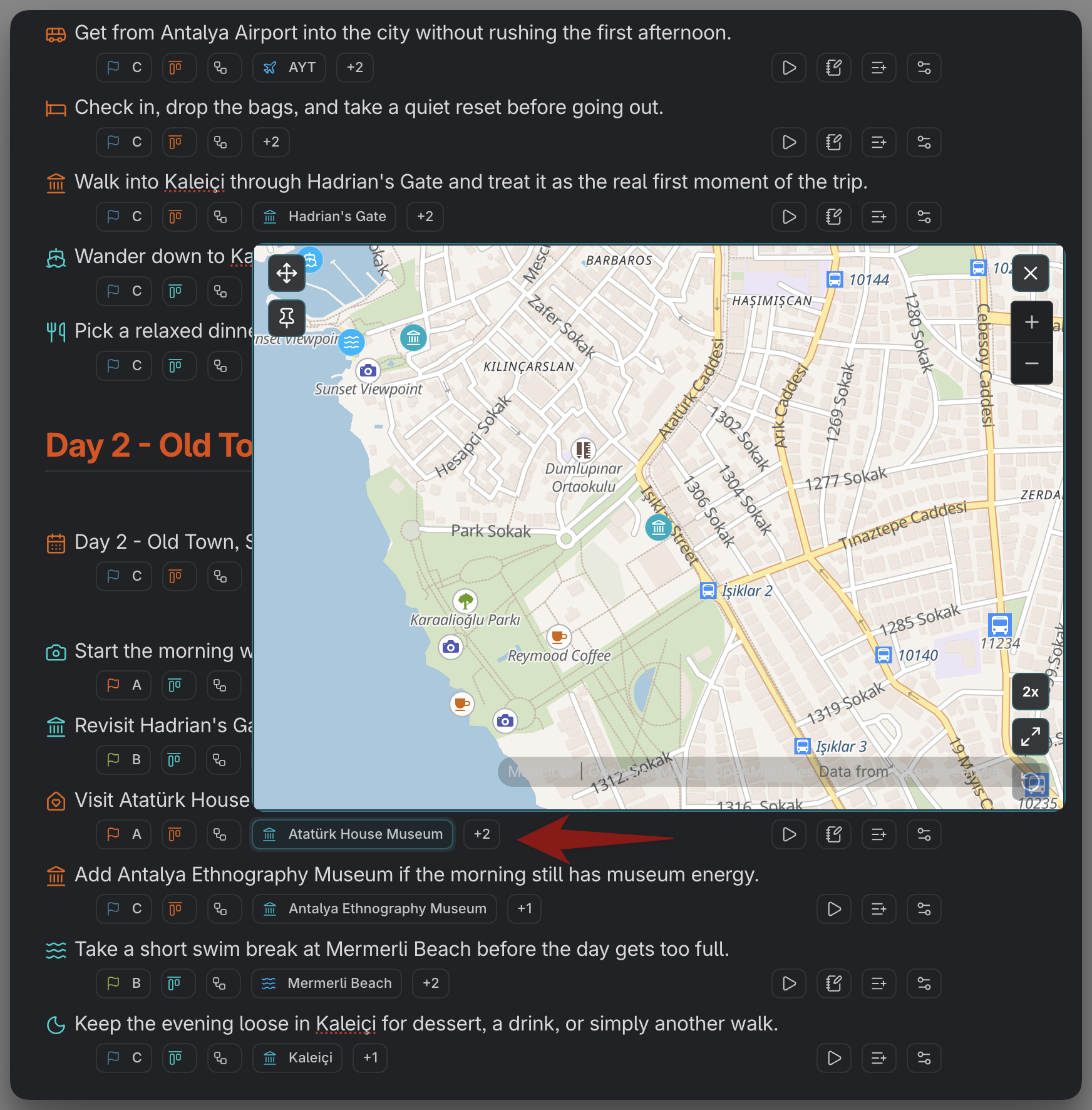
Location is a special chip. The location field stores coordinates as latitude, longitude, and Operon shows it as a map chip rather than plain text. Clicking it opens a small map popover you can pan around. Drag the map and the popover pins open, staying in view for continuous reference instead of closing when you move away; a pin control toggles that state.
The chip works on its own from your coordinates or a place note. If the community Maps plugin is enabled, the popover gains a rendered map; without it you still get a working location chip and popover, just without the drawn map. A place note can also supply the marker's icon and color. See Location picker.
MEDIA-DOCS-041-3: The location chip's map popover pinned open after dragging the map.
Custom-key chips behave like their type
A custom key shown as a chip inherits the behavior of its type. A custom list or text field whose value is a wikilink behaves like the built-in link chips: click to open the note (creating it if it does not exist yet), Cmd or Ctrl and hover for a preview. So once you turn on "Show in chips" for a custom key, its chip is not just a label, it carries the same click and preview behavior as the built-in fields of the same shape. See Custom keys.
Settings
Chip configuration lives in Settings → Operon → Interface → Task Chips, with a separate page for each surface: Inline Task Chips, Filter Task Chips, Task Finder Chips, Kanban Task Chips, Task Wikilink Overlay Chips, and Task Card Chips. On each you set which chips show, their order, and which are Icon Only. The location chip's rendered map preview is configured in Settings → Operon → Interface → Location Map.
FAQ
Can I show only icons to save space? Yes. Set a chip to Icon Only, and it shows its icon without the text; click it to preview the full content.
Can the same chips differ between Filter View and inline tasks? Yes. Each surface has its own visibility, order, and Icon Only settings.
Do Kanban chips work on mobile? They are visible on mobile Kanban cards, but read-only. Use the card itself for opening, scrolling, and long-press dragging.
Why is my due date chip red or blue? Red means overdue, blue means due today. A finished or cancelled task drops the color.
Can a custom field be a chip? Yes. Enable "Show in chips" for the custom key, and a wikilink value behaves like a link chip. See Custom keys.
Do I need the Maps plugin for locations? No. The location chip and its popover work from coordinates or a place note on their own. The Maps plugin only adds the rendered map.
Why do I not see reminder chips? They are hidden by default on every surface. Turn them on for the surfaces you want under Settings → Operon → Interface → Task Chips.
A reminder chip says "Unresolved". What is wrong? It is a rule whose reference date is missing, so there is nothing to count back from. Set that date and it resolves again. See Reminder rules.